
The Rise of AI-Native ERPs and What It Means for Your Finance Architecture
If you closed the books this month the way you did five years ago — pulling bank statements, matching transactions in spreadsheets, chasing approvals across email — you're not alone. The infrastructure underneath, though, has started to shift faster than it has in decades.
In 2025, well over $300 million in venture capital went into a new generation of enterprise resource planning (ERP) startups designed for a world where AI sits at the core of how finance teams work. That kind of capital reshapes what's considered standard, and the decisions you make about your ERP and treasury infrastructure now will shape how your team operates for years to come.
Where ERP is heading
ERP has always been in motion. The move from on-premise to cloud redefined how companies deployed and managed their systems, and established platforms like Oracle NetSuite, SAP S/4HANA, Microsoft Dynamics 365, and Workday keep investing in cloud-native capabilities, AI features, and partner integrations.
Alongside that evolution, a new class of ERP has appeared, pushed along by a few converging shifts. The biggest is that AI models reached a point in the past couple of years where they can handle core accounting workflows reliably on live financial data. The accounting talent squeeze is severe too, with 75% of CPAs set to retire within the decade. And companies are scaling across borders faster than ever, often outgrowing their accounting systems before the implementation finishes.
The new platforms are built for that reality. Implementations that used to take months can run in weeks, and month-end close has moved from a multi-week project to a few days. Transaction categorization, reconciliation, anomaly detection, and reporting all run on models that improve with use.
Who's building the new platforms
ERP is one of the largest categories in enterprise software, anchoring how companies record transactions, manage accounting, and report on financial performance. The market has long been dominated by a handful of incumbents that grew up in the on-premise era and have since extended into the cloud. Those platforms remain the default for large enterprises, but a gap opened up underneath them: fast-growing companies that have outgrown entry-level tools like QuickBooks or Xero but find traditional mid-market and enterprise ERPs too heavy, too slow to implement, and too expensive to run.
A new generation of entrants is going after that gap, and several companies are working at it from different angles, with the shared bet that the general ledger is ready for reinvention.
Campfire
Campfire closed a $65 million Series B just 12 weeks after its $35 million Series A, bringing total funding past $100 million in under a year. Its bet is AI built into the accounting workflow itself, including LAM (a proprietary large accounting model) and Ember AI, a conversational assistant that lets finance teams query data and build reports in plain language. The company reports 10x revenue growth this year and customers migrating off legacy enterprise ERPs to consolidate on the platform.
Rillet
Rillet takes a "built by accountants" angle. Its Chief Product Officer is a former EY controller, and the product focuses on automated close management, GAAP reporting, and native ASC 606 revenue recognition. The company has raised over $100 million in under a year from Andreessen Horowitz, ICONIQ, and Sequoia, and counts more than 200 customers in its first year, including pre-IPO businesses closing the books in days rather than weeks.
Light
Light positions itself as a "Smart Financial Platform" for companies scaling across borders, automating multi-currency bookkeeping, real-time reporting, and AI-powered pre-accounting. It raised $30 million in Series A led by Balderton Capital in 2025 and cites Lovable, KeyShot, and Xaver among its customers.
DualEntry
DualEntry grew out of frustration. Its founders scaled a previous business to nine-figure revenue and went through what they describe as a bruising legacy ERP implementation. The result is a platform that promises to get companies live within 24 hours through an AI-powered migration engine.
What "AI-native" really means
The term gets used loosely, so it's worth being precise about it. Adding a chatbot or a copilot to an existing ERP is valuable, and most established platforms are doing exactly this. But AI-native means something more fundamental.
In this context, AI-native means the data architecture, the transaction processing layer, and the workflow logic were all designed from day one for AI to operate on. The general ledger holds clean, granular data that updates as transactions occur, rather than relying on batch imports and end-of-day reconciliations. That continuous, structured view is what gives models the context they need to automate routine work reliably.
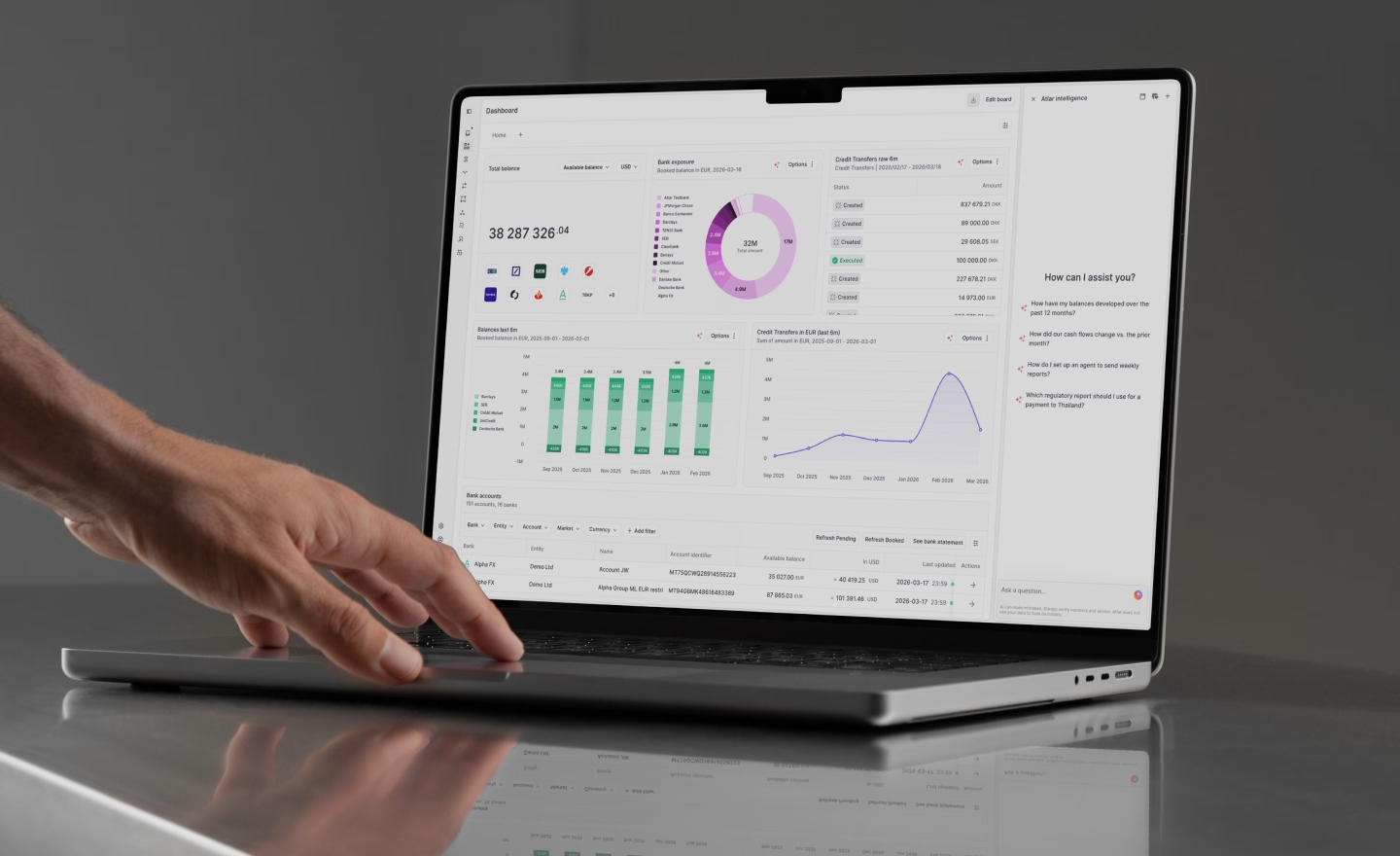
The same logic applies to treasury, which is why Atlar built Atlar Intelligence and, more recently, AI agents for treasury that handle workflows like cash positioning and payment briefings on their own. These are capabilities built into a platform that runs on real-time bank and ERP data.
Why the bank account is a different problem
The new ERPs are doing real work on the ledger. But the moment you move from the ledger to the bank account, the nature of the problem changes. Accounting runs on data the company already holds. Treasury runs on the bank, which sits outside the ERP. Connecting to it means real-time cash visibility across dozens of accounts, multi-bank connectivity, payment execution with proper approval chains, cash flow forecasting, and liquidity management.
No ERP was designed to handle bank connectivity, payment execution, and liquidity management on top of accounting.
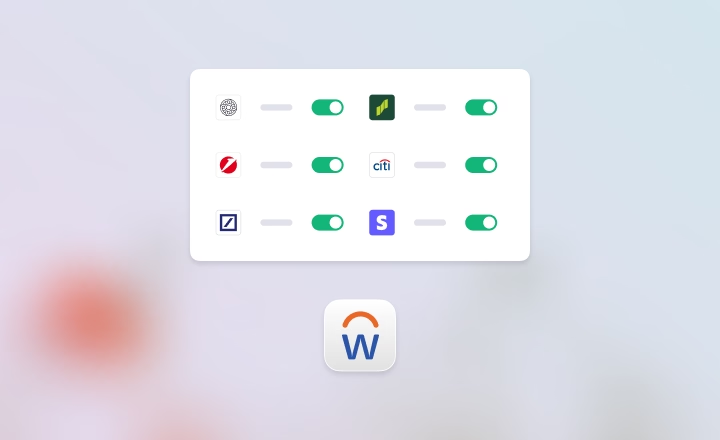
The pattern in well-run finance teams is a composable setup, where the ERP handles accounting and reporting, a dedicated treasury platform handles cash, payments, and liquidity, and clean integrations keep the two in sync so AI can operate across both.
Where Atlar fits in
Three of these AI-native ERPs are already plugged into Atlar.
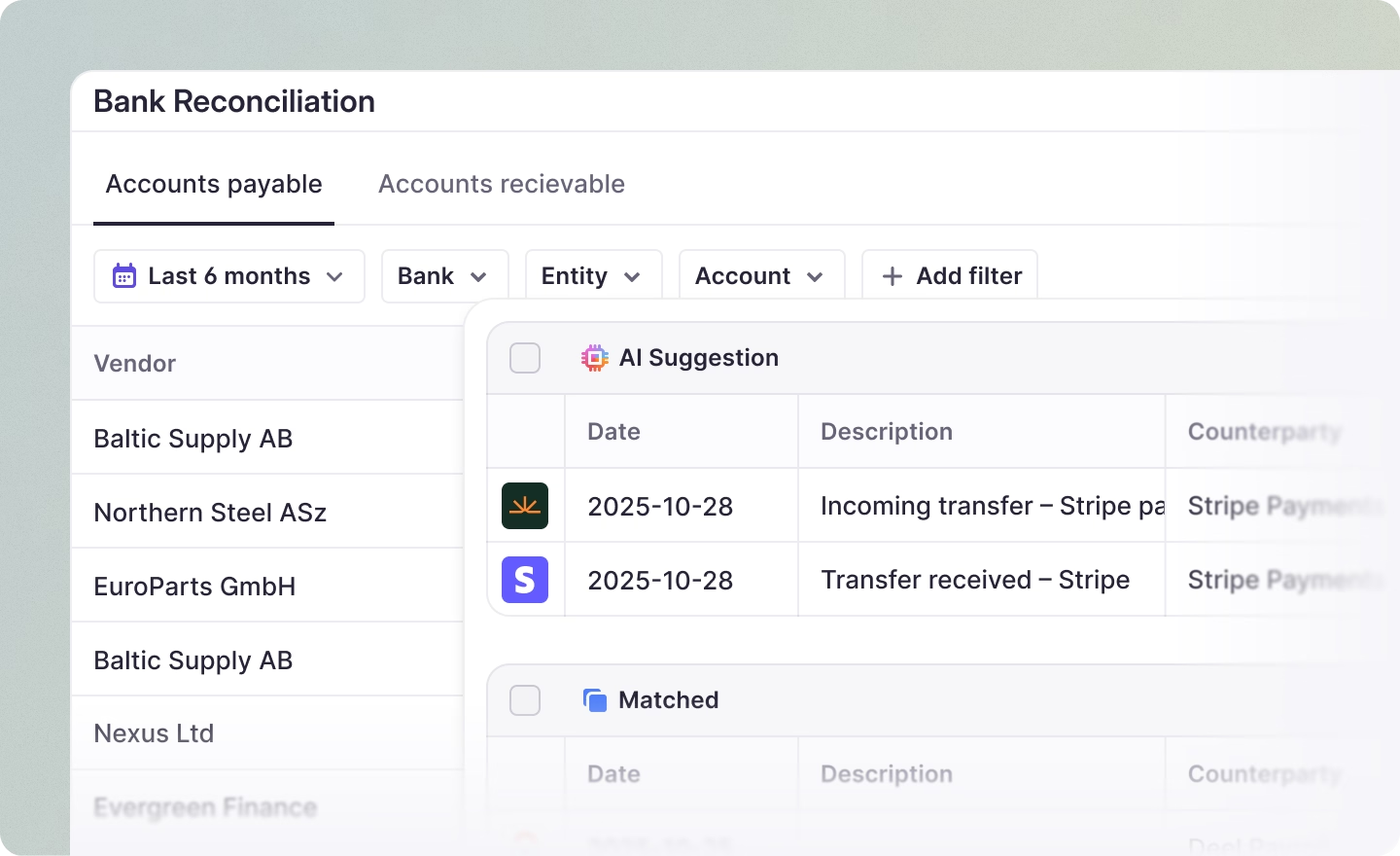
Campfire and Atlar embed Atlar's bank connectivity directly inside Campfire's AI-native ERP. Campfire's close automation and Atlar's agents work from the same real-time bank and ledger data, without anyone moving files between the two systems. Flex, an AI-native private bank for business owners that has raised more than $100 million and grown revenue 4x year-over-year, is among the early customers on the Campfire integration.
With Rillet, Atlar sits between the ERP and the bank to handle statement imports, payment runs, and reconciliation. Finance teams trigger and track payments from inside Rillet, with approval chains and supplier setup carrying over unchanged.
The partnership between Light and Atlar put bank connectivity directly inside Light's accounting platform, so finance teams can run AI across the full workflow rather than across two systems that don't talk to each other. Lovable, one of Europe's fastest-growing AI companies and a customer of both, was among the first to go live.
A modular finance stack
The bigger pattern is that finance architecture is becoming modular: accounting in one layer designed for it, treasury in another, with clean data flowing between them and AI operating across both.
For most teams, this isn't a rip-and-replace decision. Established ERPs still anchor accounting at scale, and the major platforms are investing heavily in AI capabilities of their own. What matters is whether the treasury layer can operate at the same tempo, and whether the two are connected cleanly enough that AI can work across both.
Whether your ERP is NetSuite, Dynamics 365, SAP S/4HANA, or one of the AI-native entrants, the treasury layer connects the same way. The only question is whether yours is keeping pace.
Teams at Lovable, Flex, Acne Studios, GetYourGuide, Mangopay, and Tide use Atlar alongside their ERPs to manage cash, payments, forecasting, and more. On G2, Atlar holds a 5-star rating, the highest of any treasury management system on the platform.
If you're weighing up ERPs, our partnerships team works across all of these platforms and can give you an impartial read on which fits your setup, including introductions where it helps. Get in touch or reach out at partnerships@atlar.com.
_NEF-EDIT.avif)
You can unsubscribe anytime.
Most recent

See Atlar in action.
Enter your work email to watch a live product demo.